June 2026
Best Practices, Data and Analytics, Industry Insights, SEO
38 min read
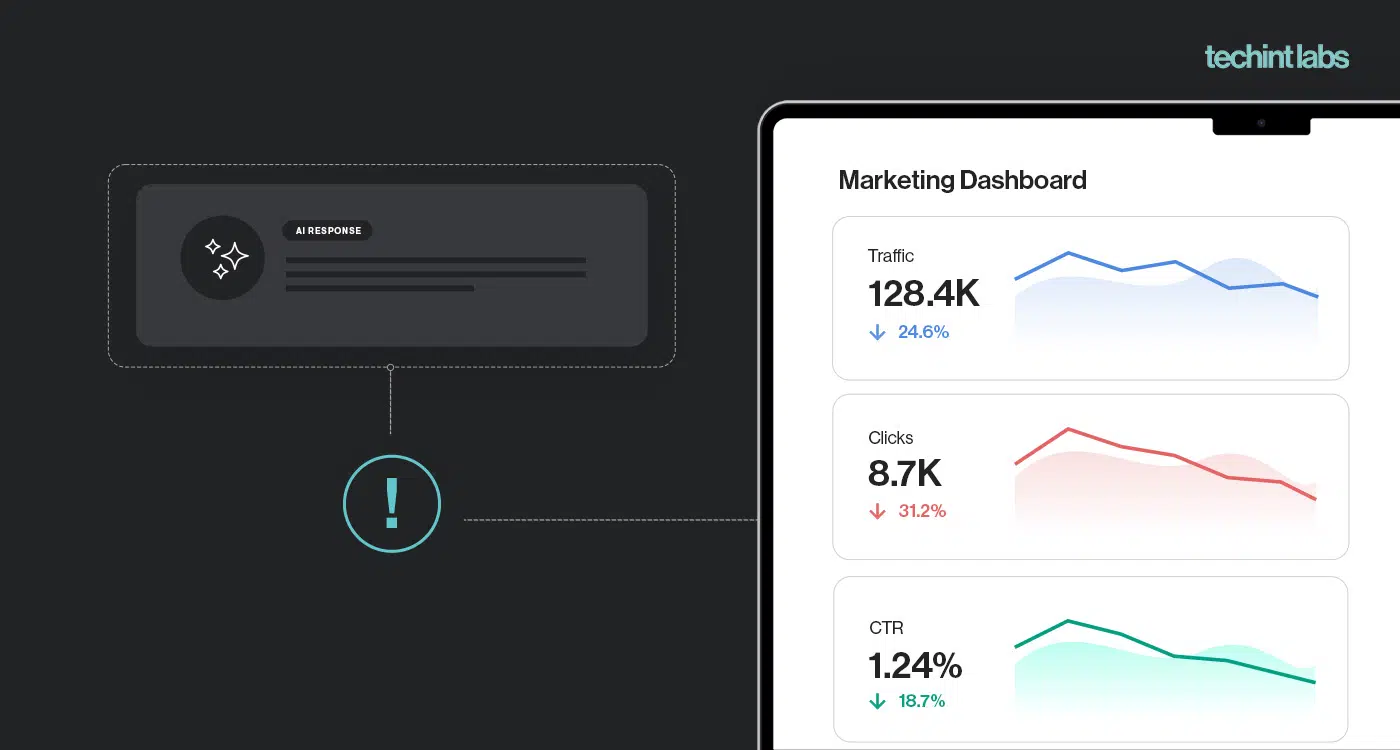
If you open your Google Analytics dashboard today, there’s a good chance you’re watching mis-measured traffic. Organic traffic is declining, click-through rates are falling, and long-standing performance benchmarks suddenly seem unreliable.
At first glance, those numbers suggest a loss of visibility. In many cases, the opposite is happening.
The way people discover information online is changing. Instead of clicking through multiple search results, users increasingly get answers directly from AI-powered search experiences. Platforms like Google AI Overviews, ChatGPT, Gemini, and Perplexity can summarize information, compare solutions, and recommend brands before a user ever visits a website.
For marketers, that evolution creates a new challenge. Traditional analytics platforms were built to measure clicks, sessions, and pageviews. Today’s buyers often complete large portions of their research journey without generating any of those signals.
Why Are Clicks Dropping While AI Brand Authority Is Rising?
Traditional analytics platforms were built around clicks, sessions, and pageviews. Today’s buyers often complete large portions of their research journey without generating any of those signals. They read an AI-generated summary, learn about a brand, and leave with the information they need. The influence occurred, but the click never happened.
As a result, many marketing teams are looking at declining traffic and assuming they’re losing market share. In reality, they may be gaining visibility in places their current reporting cannot measure.
The Baseline Shift of AI Overviews
This shift isn’t a niche trend. AI Overviews and conversational search experiences now appear in approximately 21% of U.S. searches, fundamentally changing how users interact with search results.
As AI-generated answers become more common, traffic patterns are changing alongside them. Research shows that when an AI Overview appears, traditional organic click-through rates drop by 61%, falling from an average of 1.76% to 0.61%.
The impact is especially noticeable for informational searches, which trigger the majority of AI-generated responses. Even brands with strong organic rankings can lose up to 79% of expected traffic when an AI answer appears above their listing.
Looking ahead, Gartner forecasts a 25% decline in traditional search engine volume as users continue shifting toward generative AI tools and virtual assistants. Together, these trends point to a new reality: fewer clicks do not automatically mean less influence.
Why is Traditional Measurement Breaking Right Now?
The marketing industry has spent decades building attribution models around visits. As AI-driven discovery grows, that foundation becomes less reliable.
The Zero-Visit Visibility Trap
For years, marketers measured success through a relatively straightforward model: a user searched for information, clicked a result, visited a website, and took an action. Traffic served as a reliable proxy for visibility and influence. If visits increased, marketers could reasonably assume their content was reaching and engaging potential customers.
Today, 58.5% of Google searches end without a single click to an external website. That statistic changes how we should think about marketing performance. Imagine a prospect asks a detailed question about the industry. An AI platform uses information from your website, industry publications, reviews, and third-party sources to generate a complete answer. The user receives exactly what they need and never visits your site.
From a traditional analytics perspective, nothing happened. From a marketing perspective, your content successfully informed a potential customer. This disconnect creates a growing blind spot for brands that rely exclusively on session-based reporting. And it isn’t the only change affecting measurement.
The Shift From Keywords to Conversations
User behavior is changing alongside search technology. Traditional search engines treated every query as an isolated event. AI assistants operate differently. Users now engage in ongoing conversations. They ask follow-up questions, refine requests, compare options, and build context over multiple interactions.
That means content strategies can no longer focus exclusively on ranking for individual keywords. Brands must create content ecosystems that remain relevant throughout an extended conversation.
Visibility is no longer tied to a single search result. It depends on whether AI systems consistently recognize your expertise and surface your information throughout a user’s research journey. As these conversational journeys become more common, tracking influence becomes even harder with traditional attribution models.
The Attribution Gap
AI-driven discovery introduces another challenge: attribution. When an AI platform recommends a product, service, or company, users often do not click an outbound link immediately. Instead, they adopt the recommendation and return later via a direct visit or a branded search. Most analytics platforms credit that interaction as direct traffic or branded organic traffic.
The source of influence disappears. As AI becomes a larger part of the customer journey, this attribution gap will continue to grow, making traditional reporting increasingly incomplete.
How Do GEO, AEO, and LLMO Change Your Marketing Workflow?
Before marketers can measure AI visibility, they need to understand how brands become visible in AI-generated experiences in the first place. Several emerging frameworks address this challenge. While the terminology continues to evolve, they all share a common goal: helping AI systems accurately understand, trust, and recommend your brand.
-
1
Generative Engine Optimization (GEO)
Generative Engine Optimization focuses on making content easy for AI systems to discover, understand, and reference. Rather than optimizing exclusively for rankings, GEO prioritizes creating content that can be synthesized into AI-generated responses and recommendations.
-
2
Answer Engine Optimization (AEO)
Answer Engine Optimization centers on providing clear, direct responses to user questions. This approach emphasizes structured content, concise explanations, FAQ-style formats, and technical enhancements that help conversational systems retrieve accurate answers quickly.
-
3
Large Language Model Optimization (LLMO)
Large Language Model Optimization takes a broader view of brand visibility. It focuses on how your organization appears across reviews, industry publications, forums, databases, directories, and other sources that AI systems use to establish credibility and context.
Together, these approaches shift marketing from keyword ranking to a focus on becoming a trusted source of information across the entire AI ecosystem.
How Do You Measure Brand Authority When the User Never Visits Your Website?
If clicks no longer tell the full story, marketers need a different way to evaluate performance. The goal isn’t to abandon measurement. It’s to supplement traditional metrics with signals that better reflect how AI-driven discovery works. Here are five areas worth tracking.
-
1
AI Share of Voice
AI Share of Voice measures how frequently your brand appears in AI-generated responses compared to competitors. Think of it as market share for conversational search. Start by testing your most valuable commercial-intent prompts across platforms such as ChatGPT, Gemini, and Perplexity. If your brand appears in only a small percentage of relevant responses, your visibility challenge starts long before a user reaches your website.
-
2
Citation Survival Rate
Mentions matter. Citations matter more. Research shows that brands cited in AI-generated experiences receive significantly more organic traffic than brands merely referenced without attribution. Your goal should be simple: if an AI platform discusses your company, it should also provide a source citation whenever possible. A high citation survival rate indicates that your content is authoritative, trustworthy, and well-structured for retrieval.
-
3
Platform-Specific Distribution
Not all AI systems rely on the same information sources. For example, Perplexity frequently cites Reddit discussions and analyst research, while Google AI Overviews often draw on Reddit and YouTube content. That means visibility strategies must align with the platforms that influence your audience. For B2B organizations, industry publications, Gartner coverage, G2 profiles, and expert commentary often play a critical role. For B2C brands, community discussions, video content, and user-generated content may carry greater weight. Rather than optimizing for a single algorithm, brands should focus on establishing authority across the sources AI systems trust most.
-
4
Entity Clarity and Sentiment
How accurately do AI systems describe your brand? Ask a conversational AI platform what your company is known for. Review the response carefully. Are the facts accurate? Are products described correctly? Does the messaging align with your positioning? Entity clarity measures how well AI systems understand your business. Sentiment measures whether those systems describe your brand positively, negatively, or neutrally. Both metrics directly influence how potential customers perceive your organization before they ever visit your website.
-
5
Assisted Conversion Rates
AI visibility should eventually translate into business outcomes. One way to measure that impact is to compare changes in AI visibility with increases in branded search volume, direct traffic, and conversions. As your AI Share of Voice improves, you should expect corresponding increases in downstream demand signals. Many organizations already see measurable lifts in branded search activity as AI-generated recommendations become more common. While attribution remains imperfect, these patterns provide valuable evidence of AI-driven influence.
Three Ways to Build Brand Content AI Systems Can Cite
Tracking AI visibility is important, but measurement alone won’t improve performance. Organizations that consistently appear in AI-generated recommendations tend to follow a common set of best practices.
-
1
Prioritize Structure Over Fluff
AI systems reward clarity. Content should answer the primary question quickly, provide supporting evidence, and make key information easy to extract. Modern content must serve both human readers and machine interpretation. Clear headings, concise answers, and logical organization create stronger visibility opportunities than unnecessary word count. Is your content AI-ready? See our 10-point checklist for getting found in AI Search
-
2
Build a Strong Technical Foundation
Technical optimization has become a prerequisite for AI visibility. Schema markup, structured product information, accurate business listings, and consistent metadata help AI systems understand your content with confidence. If your information is difficult to interpret, it becomes less likely to appear in generated answers. The brands that win in AI search are often the brands that make retrieval easiest.
-
3
Create Multi-Modal Content
AI platforms increasingly evaluate information across multiple formats. Articles remain important, but images, videos, reviews, podcasts, and community discussions all contribute to visibility. As AI-powered assistants handle an increasing share of discovery interactions, brands need a broader content footprint that reinforces their expertise across multiple channels. The more evidence AI systems can find, the more confidently they can recommend your organization.
Is Your Content Structured for Machine Readability or just Legacy Search?
AI is not eliminating the need for digital marketing. It’s changing how influence is earned and measured. Brands with fragmented content, inconsistent information, and outdated technical foundations risk becoming invisible in AI-generated experiences. Others may find themselves misrepresented because AI systems lack the context needed to understand them accurately.
The organizations that succeed will move beyond traffic as the sole indicator of performance and adopt measurement frameworks that reflect how modern discovery actually works.
Clicks still matter. Traffic still matters. But neither tells the full story. The real question is whether your brand is being discovered, trusted, and recommended before a user ever reaches your website.
Ready to understand how visible your brand is in AI-powered search? Book a meeting with Techint Labs to audit your AI visibility, identify attribution gaps, and build a measurement strategy designed for the next generation of search.